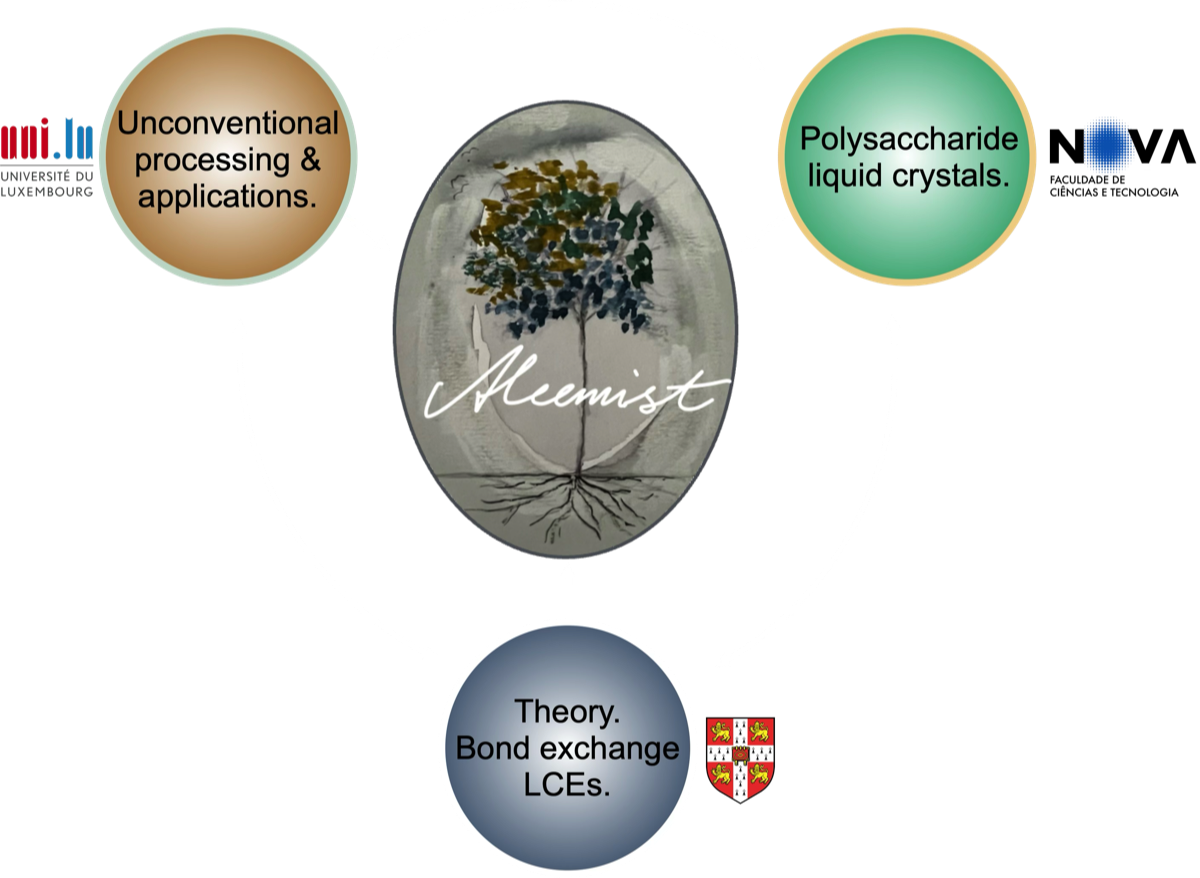
About ALCEMIST
What opportunities can arise if we rethink conventional design and construction where components are either dynamic (engines, dampers, …) or static (beams, wires, joints, …), instead benefiting from a single component playing both roles, simultaneously being a pump and a conduit, a thread and a sensor, and so on? Can such components be made and, if so, can it be done at acceptable cost, without further depleting our finite resources? In ALCEMIST, we argue that this vision becomes realistic by making liquid crystal elastomers (LCEs) in a radically new way from abundant and renewable resources.
In laymen's terms, LCEs are rubbers (elastomers) that extend and contract on their own. Like conventional rubbers, LCEs can do mechanical work, but they require no externally imposed strain to "charge" them. This gives LCEs enormous potential as soft actuators that can simultaneously function as a shape-defining material and an engine. The impact on academia, society, and industry can be significant as the innovative ALCEMIST LCE materials open new lines of interdisciplinary research and enable diverse transformative applications such as:
In laymen's terms, LCEs are rubbers (elastomers) that extend and contract on their own. Like conventional rubbers, LCEs can do mechanical work, but they require no externally imposed strain to "charge" them. This gives LCEs enormous potential as soft actuators that can simultaneously function as a shape-defining material and an engine. The impact on academia, society, and industry can be significant as the innovative ALCEMIST LCE materials open new lines of interdisciplinary research and enable diverse transformative applications such as:
- adhesives for circular economy construction that can be ‘turned off’ at will for component disassembly and recycling;
- self-cleaning water filters;
- massively-parallel converters of waste heat into work;