Publications
Perspective article on solvent-free thermotropic cellulose liquid crystals
29/06/2026
The ALCEMISTs from NOVA published an invited Perspective paper highlighting the emerging potential of solvent-free thermotropic cellulose liquid crystals as sustainable photonic materials by connecting molecular chirality, hierarchical self-assembly, processing, and optical functionality. Its main novelty is providing an integrated framework for understanding and designing adaptive cellulose-based photonic systems, directly supporting ALCEMIST's objective of establishing predictive design principles for renewable structural colour materials.
The paper, titled Cellulose-based self-assembled photonic structures: linking chirality, structure and optical function across scales, is published (open access) in Journal of Physics: Photonics, 8, 021001, 2026. Please click here to read it.
The paper, titled Cellulose-based self-assembled photonic structures: linking chirality, structure and optical function across scales, is published (open access) in Journal of Physics: Photonics, 8, 021001, 2026. Please click here to read it.
Article revealing the importance of particle concentration during ultrasonication of nanorods
09/03/2026
ALCEMIST team members Zornitza Tosheva and Jan Lagerwall (both of the ESMP group in Luxembourg) published a very thorough study that has been a long time in the making, demonstrating how the generation of shear-induced nematic phase during ultrasonication of cellulose nanocrystal (CNC) suspensions greatly improves the results of the sonication. This means that the concentration of nanoparticles during sonication, which frequently is an almost ignored parameter, plays a huge role, and this applies also to other anisometric nanoparticles, like carbon nanotubes, graphene flakes and so on.
The paper, titled Orientational ordering benefits nanorod sonication, is published (open access) in Physical Review Materials. You can read it here. And here is a Linked In post introducing the paper for a broader scientific audience.
Supplementary-video-1
The paper, titled Orientational ordering benefits nanorod sonication, is published (open access) in Physical Review Materials. You can read it here. And here is a Linked In post introducing the paper for a broader scientific audience.
Supplementary-video-1
Perspective article on the innovative application opportunites of cholesteric liquid crystals
25/02/2026
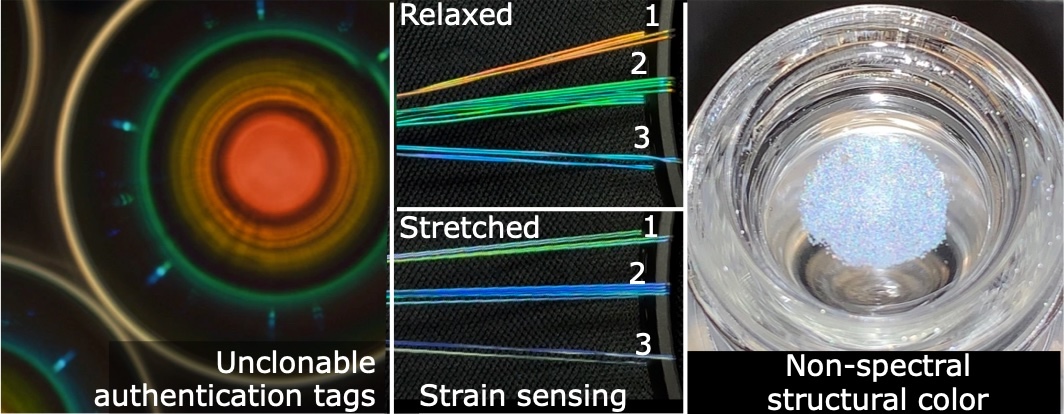
Jan was invited by ACS Accounts of Materials Research to write a perspective article which he chose to devote to cholesteric liquid crystals and their broad application opportunities. One of the featured examples are the mechanochromic CLCE fibers that play a key role in WP3 of ALCEMIST, specifically the quest to turn these into suture threads that will help robotic surgeons understand how hard they tie the suture, so they don't break them during surgery.
You can download the open access article, titled Innovative Applications Enabled by the Versatile Structural Color of Cholesteric Liquid Crystals, from the ACS AMR website.
You can download the open access article, titled Innovative Applications Enabled by the Versatile Structural Color of Cholesteric Liquid Crystals, from the ACS AMR website.
New article on defect dynamics in cholesteric liquid crystals
29/01/2026
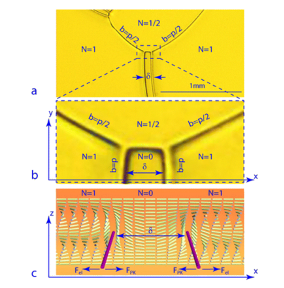
Download the (open access) article here.
New article on helical self-assembly in cellulosic liquid crystals
27/01/2026

You can download the article (open access) here.
Cholesteric liquid crystal elastomers in structural health monitoring
29/11/2024
While not a result of ALCEMIST, Jan's latest paper, together with chemist Rijeesh Kizhakidathazath and concrete engineers Tarik Čamo and Danièle Waldmann-Diederich, on using CLCEs in structural health monitoring is strongly related to the project. The paper demonstrates how the same mechanochromic response of CLCEs that will be used in strain sensing fibers in ALCEMIST can be used to detect and monitor cracks in concrete. By painting the CLCE precursor onto the object of interest, a crack developing in it is immediately revealed—much earlier than when it could be seen by the naked eye—through a local color change over the crack. This can have a great impact on detecting structural problems in bridges and other infrastructure before they fail, thus avoiding costly repairs and possibly saving lives. Read the paper that was published (open access) in the journal Structural Health Monitoring here: https://journals.sagepub.com/doi/10.1177/14759217241296831