CLCEs
NOVA ALCEMISTs at the European Researchers' Night
28/09/2026 Filed in: Outreach
On 25 September, the ALCEMIST team from NOVA University of Lisbon participated in the 2026 Noite Europeia dos Investigadores (European Researchers' Night) at the Museum of Natural History and Science (MUHNAC) of the University of Lisbon! With a strong focus this year on sustainability, this was a great venue for us to present our work on processing of liquid crystal elastomers from sustainable materials and some of the ways we can use liquid crystal elastomers in sustainability applications.
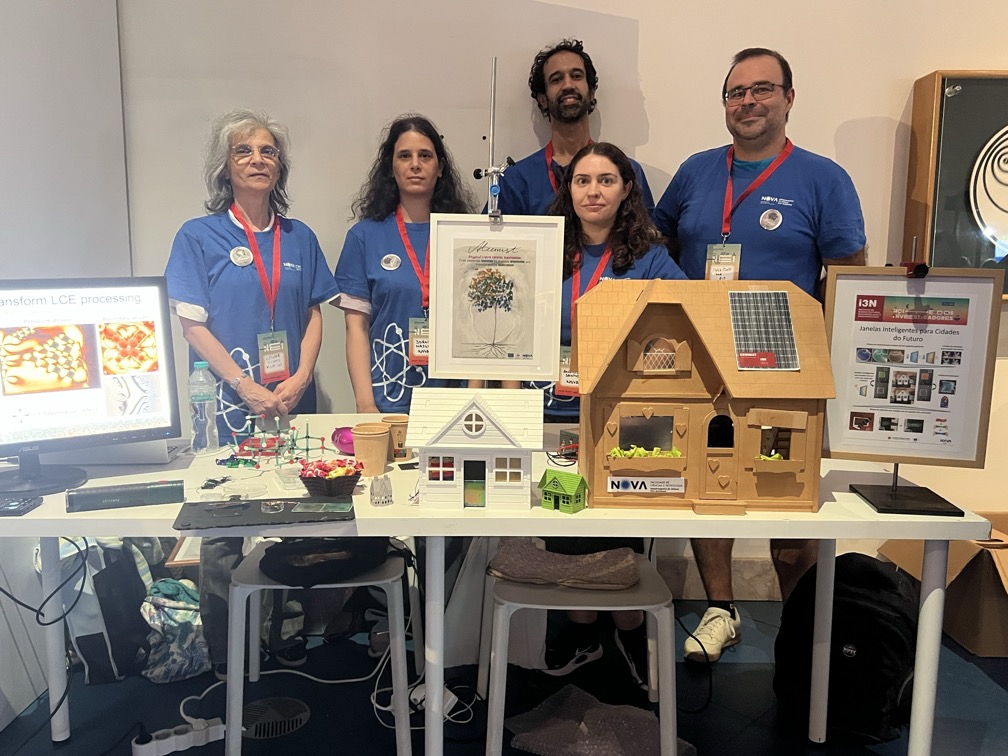
photo credit: Lena Godinho
Perspective article on the innovative application opportunites of cholesteric liquid crystals
25/02/2026 Filed in: Publications
Jan was invited by ACS Accounts of Materials Research to write a perspective article which he chose to devote to cholesteric liquid crystals and their broad application opportunities. One of the featured examples are the mechanochromic CLCE fibers that play a key role in WP3 of ALCEMIST, specifically the quest to turn these into suture threads that will help robotic surgeons understand how hard they tie the suture, so they don't break them during surgery.
You can download the open access article, titled Innovative Applications Enabled by the Versatile Structural Color of Cholesteric Liquid Crystals, from the ACS AMR website.
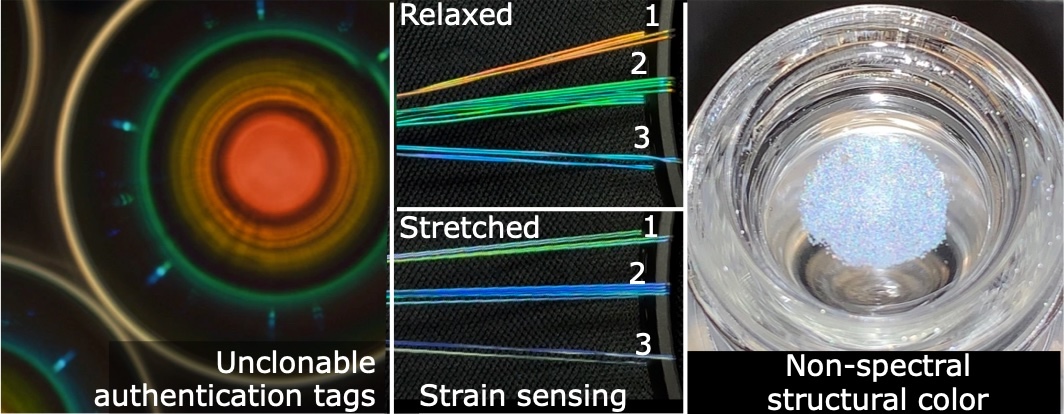
You can download the open access article, titled Innovative Applications Enabled by the Versatile Structural Color of Cholesteric Liquid Crystals, from the ACS AMR website.
Cholesteric liquid crystal elastomers in structural health monitoring
29/11/2024 Filed in: Publications
While not a result of ALCEMIST, Jan's latest paper, together with chemist Rijeesh Kizhakidathazath and concrete engineers Tarik Čamo and Danièle Waldmann-Diederich, on using CLCEs in structural health monitoring is strongly related to the project. The paper demonstrates how the same mechanochromic response of CLCEs that will be used in strain sensing fibers in ALCEMIST can be used to detect and monitor cracks in concrete. By painting the CLCE precursor onto the object of interest, a crack developing in it is immediately revealed—much earlier than when it could be seen by the naked eye—through a local color change over the crack. This can have a great impact on detecting structural problems in bridges and other infrastructure before they fail, thus avoiding costly repairs and possibly saving lives. Read the paper that was published (open access) in the journal Structural Health Monitoring here: https://journals.sagepub.com/doi/10.1177/14759217241296831