09 March 2023
Welcome to Valentin (left) and Claudia (right)
Valentin and Claudia join our group for their bachelor project.
Valentin will work on Computer simulation of evaporative flows during cholesteric liquid crystal elastomer preparation.
Claudia will work together with Deniz on finding the refractive indices of nematic liquid crystal mixture.
\XM
01 March 2022
Welcome to Axel (left) and Yosuke (right)
Axel and Yosuke join our group for their bachelor project.
Axel will investigate the isotropic-nematic phase transition of liquid crystal oligomers and the impact of the concentration of chiral dopant on the ground-state color of cholesteric liquid crystal elastomers (CLCEs).
Yosuke will study the small-scale limit of cholesteric spherical reflectors (CSRs).
\XM
15 March 2018
Welcome to our new bachelors student - Joana!
She will be learning microfluidic LC shell production and be working with Rao for the next few months :)

/CGR/
30 September 2016
Congratulations to JungHyun and Benjamin for their new
Adv. Mater. paper "
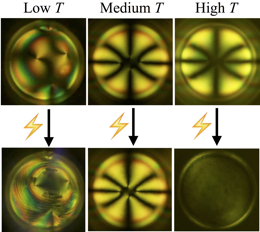
Taming Liquid Crystal Self-Assembly: The Multifaceted Response of Nematic and Smectic Shells to Polymerization" on polymer-stabilization of nematic and smectic liquid crystal shells, and the sometimes unexpected consequences for the liquid crystal self-assembly. By polymerizing a small fraction of the reactive mesogen RM257 in shells of 8CB or its homologues, certain defect configurations can be locked in place, the exact result depending sensitively on the mixture composition and the temperature at which polymerization is carried out. Surprisingly, when polymerizing close to a phase boundary, a transition into the adjacent phase can be induced. The new phase can be more or less ordered, depending on the starting situation. The lifetime of the shells is dramatically enhanced, as is the temperature stability. By tuning the conditions, the self-assembled structure can be made fully permanent, being visible even upon heating to the isotropic phase of the non-polymerized component, or it can be retained in a latent state, allowing macroscopic loss of order on heating to the isotropic phase yet with a memory of the chosen defect configuration when cooling down. Apart from proposing explanations for the various observations we discuss possibilities to apply the polymer-stabilized shells, for instance in advanced materials generation or in sensing.
Here you can find the full paper (don't forget to check out the rich supporting information, including many spectactular movies), and here is a layman's abstract for the paper.
23 December 2015
Just in time for Christmas,
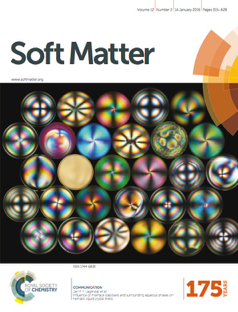
JungHyun's beautiful collection of liquid crystal shells got to decorate the
cover of issue 2 of volume 12 of Soft Matter. Her article "
Influence of interface stabilisers and surrounding aqueous phases on nematic liquid crystal shells", written together with
Kevin and
Jan, appears on page 367 of this issue. Congratulations on your second journal cover, JungHyun!
26 October 2015
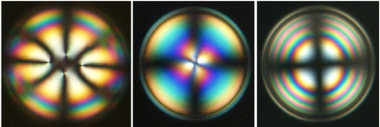
Congratulations to JungHyun and Kevin! During Kevin's bachelor thesis work (supervised by JungHyun) they discovered a very surprising textural change during the nematic-isotropic transition of liquid crystal shells. This became the start of a detailed investigation of what the substances that surround liquid crystal shells, typically surfactants and random coil polymers dissolved in aqueous mixtures, actually do to the liquid crystal. Now this study has been accepted for publication as a Communication in
Soft Matter.
You can download the 'just accepted' version here, and you will then see that water actually enters the liquid crystal, affecting its clearing point, and surfactant can go through from one side to the other, turning a hybrid shell uniformly homeotropic after some time. On the other hand, if the surfactant concentration is too low, the alignment is planar, because then the planar-aligning influence of water dominates. Polymers like PVA just stabilize the shells, they don't affect the alignment.