06 July 2026
Congratulations to Jan and to our collaborators in
Frank Gießelmann's group at the University of Stuttgart and in Per Rudquist's group at Chalmers University of Technology for their latest publication in
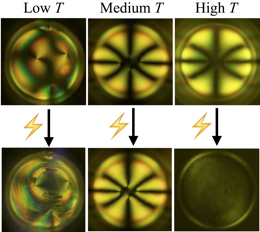
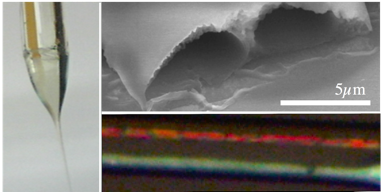
npj Soft Matter, "Electrospun fibers with axially polarized ferroelectric nematic core"! A combination of our longstanding electrospinning work with the exciting and emerging world of ferroelectric nematic liquid crystals, this work reports on the results of electrospinning polymer fibers containing a ferroelectric nematic liquid crystal core. The unique properties of ferroelectric nematics suppress the onset of Rayleigh–Plateau instability, giving rise to very easy, continuous filling and unusual behavior in the fibers.
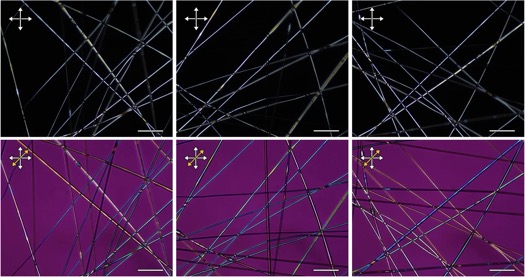
The article is open access and free to read. Congrats again to the team!
/LWH/
09 March 2026
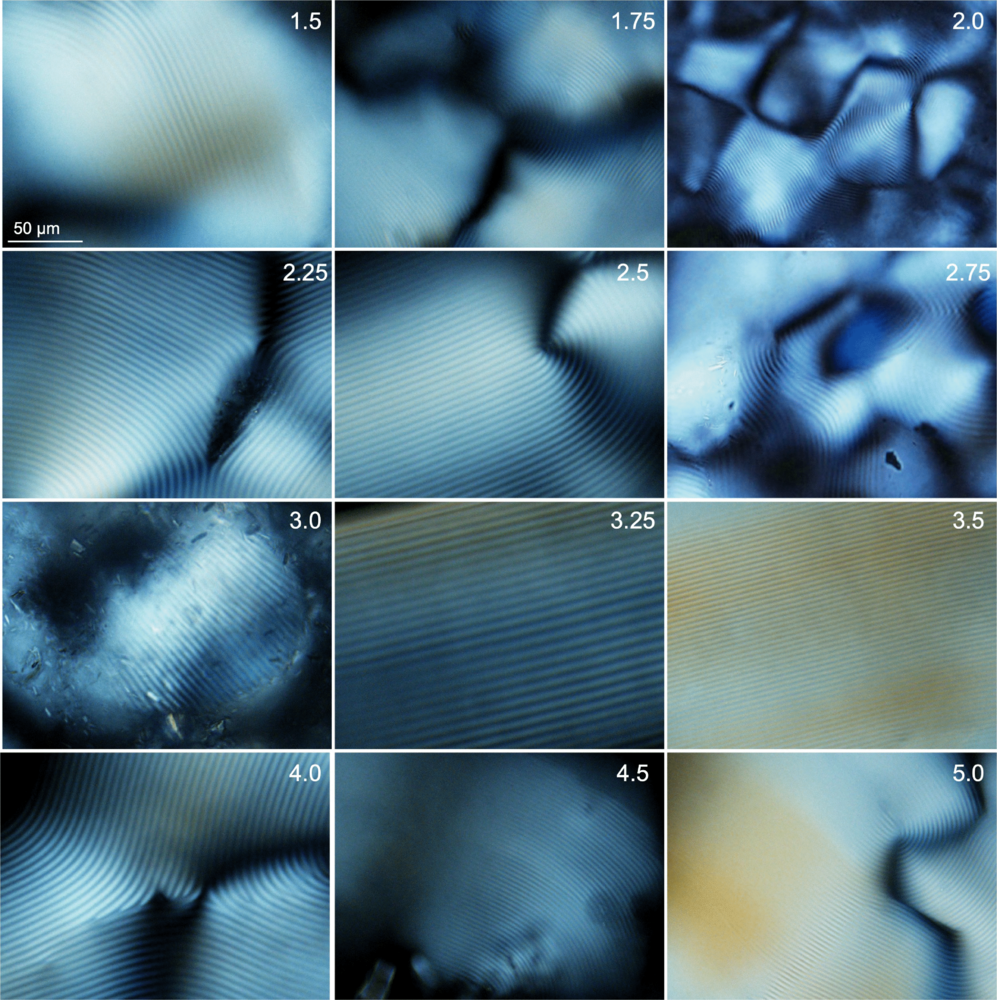
Congratulations to Zory and Jan on their latest publication, "Orientational ordering benefits nanorod sonication", which
went online today in Physical Review Materials! A work very long in the making, this is a systematic study of the interplay between sonication and ordering in suspensions of rods (in particular, the cellulose nanocrystals we use) and how phase transitions ultimately affect the behavior of the suspensions (even after returning to the "original" state).
The article is free to read (and download) online.
/LWH/
30 January 2026
Congratulations to ESMP alumna Deniz Avşar and ESMP overlord Jan on their newest publication in
Advanced Optical Materials, "
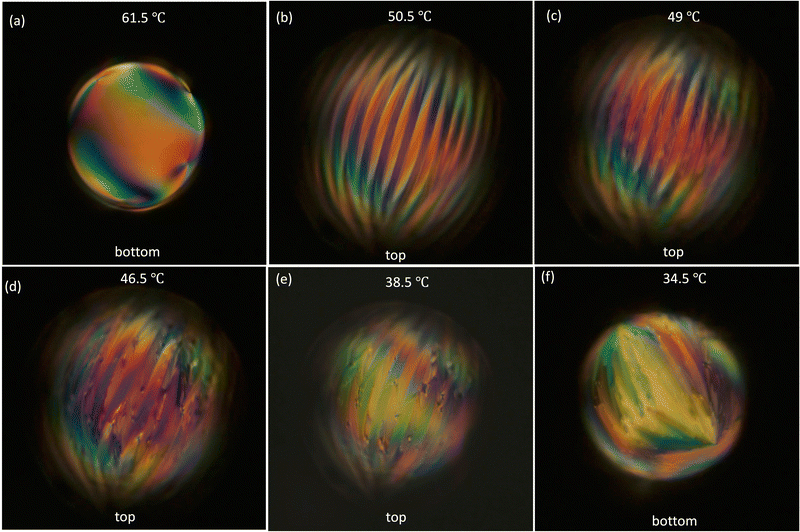
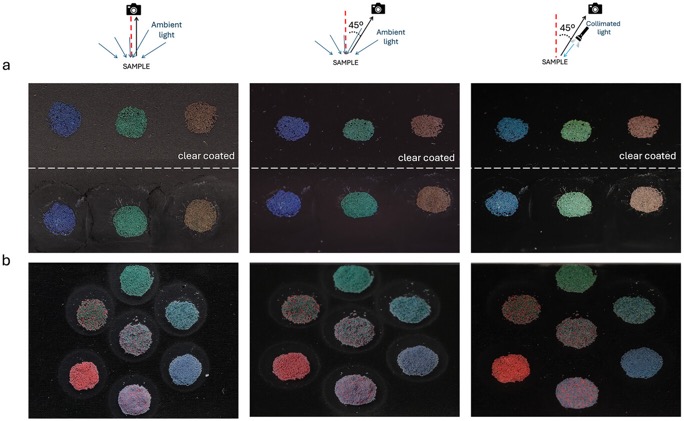
Circularly Polarized Structural Color Pigments Tunable Across the Full Visible Spectrum"! In this work, inspired in part by jewel beetles, Deniz and Jan (though especially Deniz) explore the camouflaging of patterns sensitive to circular polarization by using cholesteric spherical reflectors. By color mixing and dye infusion, they achieved color combinations that are virtually invisible to the unaided eye, but become very apparent when viewed through circular polarizers (like some of the glasses used for watching 3D movies in 3D).
The article is open access and free to read; a great start to 2026.
/LWH/
27 March 2025
Congrats to Najiya and Jan for their recent publication, "
Oligomer-Derived Photoresponsive Liquid Crystal Elastomers with Biocompatible Operating Temperature", in
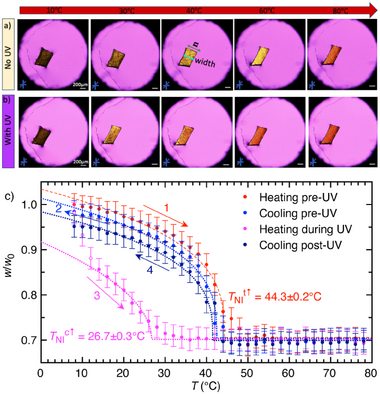
Advanced Optical Materials! In this work, they demonstrate liquid crystal elastomers capable of responding to light at temperatures close to body temperature, a step towards the aim of the ECLECTIC project of producing liquid crystal elastomer actuators for artificial vasculature. Accepted just in time for Najiya's recent PhD defense, it's now finally online for all to see.
\LWH\
11 December 2024
Congratulations to Yansong, Jan, alumni Rijeesh and Hakam, and our collaborators in the Laboratory for Photovoltaics for their recent publication, "Arbitrary and active colouring of solar cells with negligible loss of efficiency", in Energy & Environmental Science! As part of the FNR-funded project LETZCOLOR, this recent work explores the use of polymerized liquid crystals to beautify solar cell panels without any cost to the performance of the panels.
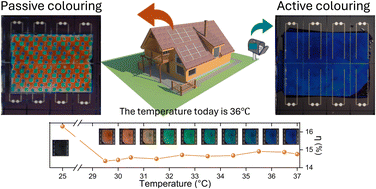
The article is free to access and read; a very nice way to end the year!
\LWH\
29 March 2023
Congrats to our alumni Anjali, Rijeesh and Jan for a
recent paper: Impact of mesogenic aromaticity and cyano termination on the alignment and stability of liquid crystal shells.
\ XM
07 August 2020
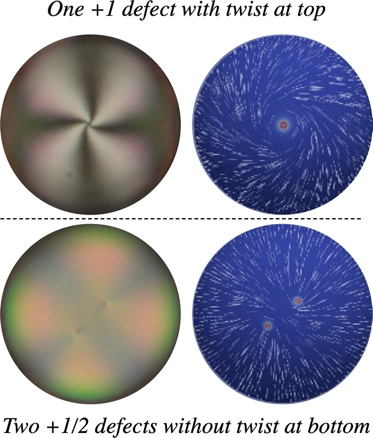
Many congratulations to JungHyun, Jan and the team for the recent paper "
Dynamic tuning of the director field in liquid crystal shells using block copolymers" published in Physical Review Research.
\AS
31 May 2020
Many congratulations to Catherine and Jan for the new article "
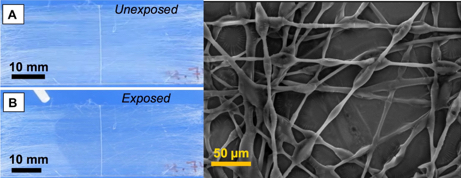
Disruption of electrospinning due to water condensation into the Taylor cone", published in
ACS Applied Materials & Interfaces. This paper has open access.
\AS
03 September 2019
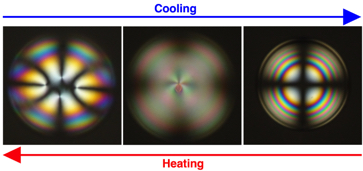
Congratulations to Anjali, Jampani, and Jan on their new article published in Langmuir: "
Realignment of liquid crystal shells driven by temperature-dependent surfactant solubility"This is the study of nematic LC shells stabilized by temperature responsive surfactant. Study shows how one can change the alignment of LC just by varying the temperature. Click
here for the full article.
\AS
29 June 2019
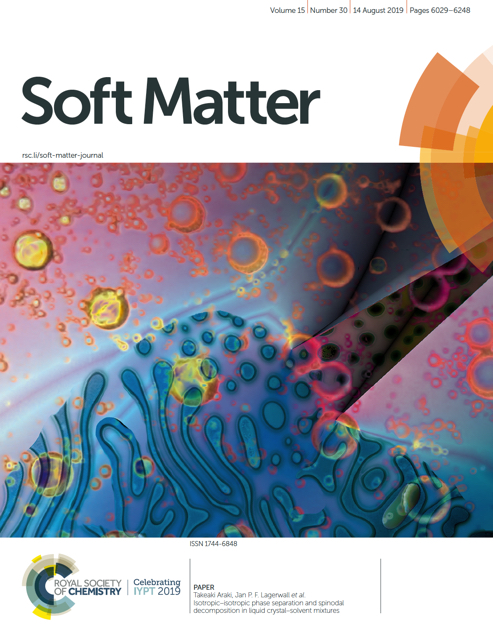
Congratulations to Catherine and Jan on the new publication RSC's Soft Matter:
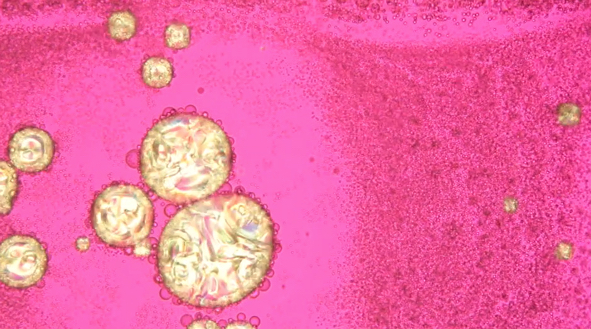
"Isotropic-Isotropic phase separation and spinodal decomposition in liquid crystal-solvent mixtures" experimentally & theoretically reveals evidence of coexisting isotropic phases in simple mixtures of ethanol, 5CB, and water. Even though the nematic LC 5CB is arguably the most studied commercial liquid crystal worldwide, for the first time this study highlights experimental evidence of spinodal decomposition and nucleation and growth occuring between two isotropic phases and a single nematic phase between this common compound and equally common solvents.
(Click the image below to visit the article:
All supplementary info is open access!)
\AS\
19 September 2018
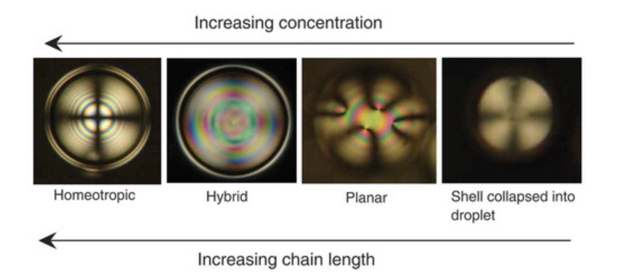
Congratulations to Anjali & Jan on the new publication in Liquid Crystals: "Influence of head group and chain length of surfactants used for stabilising liquid crystal shells"
This is the systematic study of the effect of different surfactants on Nematic LC shell, in terms of stability and alignment.
/AS/
24 May 2018
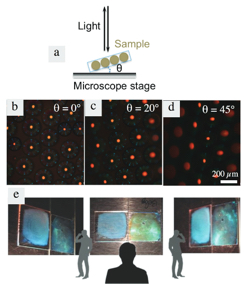
(Click the image above to read the article online, it is Open-Access)
Congratulations to Mat & Jan on the new publication in Advanced Materials: “Cholesteric Liquid Crystal Shells as Enabling Material for Information‐Rich Design and Architecture”!
Mat is a long time collaborator of Jan's since his time as a professor at SNU in South Korea. Some of us in the group got the chance to meet him, but eventually we'll all see each other again in a few days when Mat stops by our lab. Originally an architect by training, Mat worked on (and is probably still working on) many interdisciplinary projects involving robotics, and functional architecture design. He is currently a professor at the New Jersey Institute of Technology.
In this new article Mat, Jan and a few other collaborators at the SNT (Security, Reliability and Trust) Centre in Luxembourg discuss the possibilities of using cholesteric LC shells as sources for information technology in various architecture, drone, and robotics concepts and applications.
/CGR/
29 March 2018
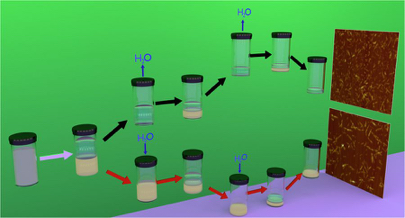
(Click the image above to read the article online, it is Open-Access)
Congratulations to Camila, Christina & Jan on the publication in Nature Asia Materials: "Fractionation of cellulose nanocrystals: enhancing liquid crystal ordering without promoting gelation" !
In a successful collaboration with Prof. Roland Sanctuary's group here at the physics & materials science research unit, this latest research on CNCs (cellulose nano crystals) describes in detail how controlling the fractionation of CNCs according to length can help in preventing the onset of gelation in solutions. The experimental results are discussed against what is already known regarding the aggregation of colloids based on the presence of counterions, and what still needs to be established in the field.
According to the authors: "Our results shine new light on the competition between liquid crystal formation and gelation in nanoparticle suspensions and provide a path for enhanced control of CNC self-organization for applications in photonic crystal paper or advanced composites."
/CGR/
15 March 2018
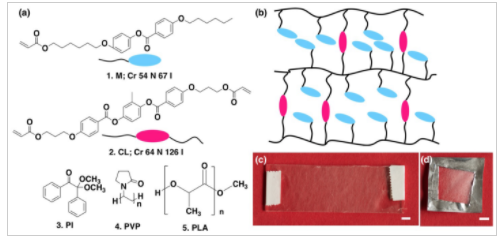
(Click the graphical abstract above to read the article online, it is Open-Access)
Congratulations to Anshul & Jan on the publication in Materials: “Electrospun Composite Liquid Crystal Elastomer Fibers”!
This is the first study to date that shows and analyzes the irreversible actuation of photo-crosslinkable reactive mesogens single axially electrospun with a carrier polymer, to create liquid crystal elastomer (LCE) fibers. Don't forget to check out the supplementary info for more details!
/CGR/
19 February 2018
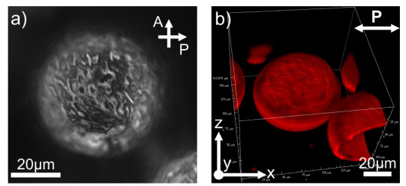
(Click the figure image above to access the article online, please email Jan if you cannot download the pdf file)
Congratulations to JungHyun & Rao on the publication in the Journal of Molecular Liquids titled: “Sub-second dynamic phototuning of alignment in azodendrimer-doped nematic liquid crystal shells”!
For the 1st time(!!), a study documents the photoswitching of azodendrimer in liquid crystal shells produced by microfluidics. Ultimately, our group members & colleagues find that phase separation may occur in shells when the dendrimer is in the trans ground state, and that photo switching turns such shells uniform - further indicating that the cis state is better soluble in the LC.
Hooray for the good start to the 2018 year :D
(Fyi - Also, I think this paper is the 1st to show results obtained from our new confocal microscope as well…so HD, so cool)
/CGR/
19 February 2018
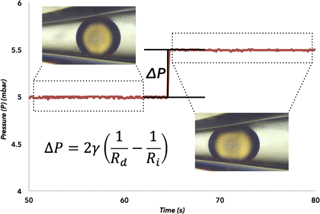
(Click the graphical abstract image above to access the article online, please email either Jan or Rao if you cannot download the pdf file)
Congratulations to Larry & Rao on the publication in Langmuir titled: “Microfluidic Tensiometry Technique for the Characterization of the Interfacial Tension between Immiscible Liquids”!
This is Larry's 1st paper in our group (!) and also Rao's 1st time serving as last author on a paper (!)
In this study, Larry and Rao borrow inspiration from the biologists and use the novel technique of micropipette aspiration (commonly used to measure the viscoelastic properties of living cells) to measure the interfacial tension of 5CB, water, and surfactants with a high degree of accuracy (from the sub-millinewton per meter to several hundred millinewton per meter range) solely from experimental observations of the droplet deformation. This is highly unique as information on the liquid density is not needed to find the interfacial tension.
/CGR/
19 February 2018
Awesome email to get:
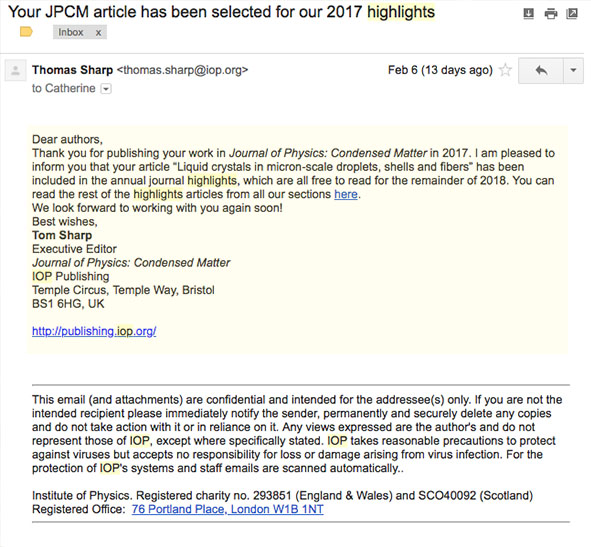
Our review on LCs in Droplets, Shells & Fibers got selected for the 2017 highlights list by IOP Publishing!! Yes mega
Congrats to our team!!
Thanks to everyone who also read &/or downloaded our article.
We put a lot of effort into trying to make a review as comprehensive, and as accurate, for those outside and in our fields as possible.
If you want to check the highlights click here (Category is: Soft matter, biophysics and liquids) -
http://iopscience.iop.org/journal/0953-8984/page/Highlights-2017/CGR/
11 December 2017
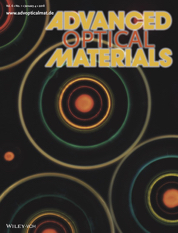
**Update (12.01.17 - POM images fromYong's paper are selected for the inside cover of Advanced Optical Materials! Click the cover above to freely access the article online)
Congratulations to Yong on the publication in Adv. Opt. Mater. titled: “Through the Spherical Looking-Glass: Asymmetry Enables Multicolored Internal Reflection in Cholesteric Liquid Crystal Shells”!
Spheres of cholesteric liquid crystal generate dynamic patterns due to selective reflection from a helical structure subject to continuously curved boundaries. In this paper the patterns are investigated exclusively.
Click here for an extended layman's abstract summary written by Jan & some info about the curious Alice in Wonderland-like title :)
/CGR/
01 September 2017
(click the above image to access the article online)
Congratulations to Martin on the publication in J. Mater. Chem. C of his dielectric spectroscopy study “Why organically functionalized nanoparticles increase the electrical conductivity of nematic liquid crystal dispersions”!
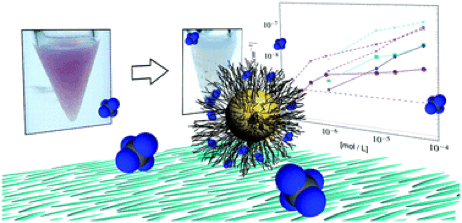
This paper gives a first systematic study of how and why nanoparticle doping raises the electrical conductivity of thermotropic liquid crystals like the commonly studied 5CB. By a careful analysis of the dielectric spectra, he shows that the hydrodynamic radius of the ionic charge carrier is much smaller than the nanoparticles, ruling out the particles themselves as the source of conductivity. The ligand molecules are also not the reason, as is demonstrated by strong sonication of the dispersions, such that the ligands detached from the nanoparticles. While this causes nanoparticle aggregation and the loss of suspension stability, the effect on conductivity is negligible. The ligand shell is, however, partially responsible, because the ions giving rise to the conductivity increase are most likely remnants from the ligand-functionalized nanoparticle synthesis process. We propose that these ions are brought in with the ligand shell when the particles are dispersed in the 5CB. Interestingly, the ions appear not to be released in an isotropic and aromatic solvent such as toluene, which is often the host for commercial gold nanoparticle suspensions, but 5CB is an ideal host for their dissolution. The aliphatic ligand shell has a higher compatibility with 5CB than with toluene, thanks to the alkyl tail of 5CB, and at the same time the high polarity of the 5CB (due to the cyano group) allows better ion dissolution than in regular hexane. Finally, the nematic order of the 5CB solvent provides an anisotropic environment in which the ligands are stretched out preferentially along the director, making release of ligand-bound ions to the solvent more likely.
/JL/
17 February 2017
The J
ournal of Physics - Condensed Matter by IOP Publishing has just released our groups' newest review article titled
Liquid Crystals in Micron-Scale Droplets, Shells, and Fibers, and it's open access!
(<— Click to check it out)
With careful and succinct discussions of various topics ranging from the characterization of typical liquid crystalline (LC) phases, to the complexities surrounding LC defects under confinement, we're sure that this review will soon become known as one of the "go-to" manuals for both liquid crystal physicists, and chemists; those just beginning in the field, and veteran researchers alike.
In considering the long length of the article, we've carefully sub-sectioned the important works, advancements, and ongoing research contributing to how liquid crystals behave in each of the major curved configurations (i.e. droplets, shells, and fibers). This was done so that anyone interested in knowing more about a particular topic can easily find the right section without having to start reading from the very beginning. At the same time, we include a number of cross-references serving as reminders for the reader to review certain previously described concepts when necessary.
Finally, at the end of each configuration topic we conclude the sections by highlighting the latest research trends which the LC field has shown interest in — for LCs in droplets and shells, it ends with a discussion of active and motile LC systems (inspired by the flocking mechanism in many biological systems) and liquid crystal elastomer (LCE) actuating shells. For LCs in polymer fiber confinement, the section ends with a discussion on textile based gas responsive visual aids, and comparisons to current gas sensing systems.
Here's a brief outline of every section & contents within:
1. Intro
2. The liquid crystalline states of matter [thermotropic nematics & smectics, order parameter, clarification of terminology for LC orientations, LC deformations & elasticity, cholesterics, LC elastomers (LCEs)]
3. Liquid crystal shells and droplets [microfluidics - what it is, how it works for making LC shells & droplets; issues surrounding interface stabilization & LC alignment control within; topological defects for nematic, cholesteric, smectic droplets and shells; droplet & shell LCE actuatiors; active LC droplets & shells]
4. Core-sheath fibers with encapsulated LC [known behaviors of nematics, smectics, cholesterics in silica cylindrical capillaries; electrospinning basics for inserting LCs into polymer cylindrical (and non-cylindrical) fibers; issues surrounding solvent, polymer concentration and molecular weight choices with particular LCs; various LC molar mass types in polymer fibers; LCE fibers and gas sensing applications]
5. Outlook
/CGR/
29 December 2016
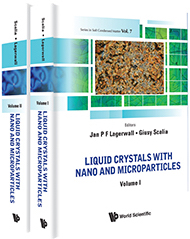
Finally, it's out! After a long process, sometimes with unexpected turns, the book edited by Giusy Scalia and Jan Lagerwall on nano and micro inclusions in liquid crystals, is now published, printed and available for purchase. "
Liquid Crystals with Nano and Microparticles" is published by World Scientific (Singapore) and you can
read all about it (and order it, on paper or as an e-book) here. Featuring the world leaders of this broad field and covering a diverse range of aspects, it ended up filling two volumes. The content is as follows (chapter authors in parentheses):
Volume 1:
1. Introduction (G Scalia and J P F Lagerwall)
I. Fundamentals:
2. A Phenomenological Introduction to Liquid Crystals and Colloids (J P F Lagerwall)
3. Nanoparticle Dispersions: A Colloid and Polymer Solution Perspective (P van der Schoot)
4. Nematic Liquid Crystals Doped with Nanoparticles: Phase Behavior and Dielectric Properties (M A Osipov and M V Gorkunov)
II: Methods for Studying Liquid Crystals and Their Inclusions:
5. Conventional and Nonlinear Optical Microscopy of Liquid Crystal Colloids (T Lee and I I Smalyukh)
6. X-Ray Scattering (G Ungar, Z Chen and X Zeng)
7. Raman Spectroscopy (H F Gleeson)
8. Manipulation of Inclusions with Optical Tweezers (M Skarabot)
9. Atomic Force Microscopy on Liquid Crystals (C Bahr and B Schulz)
III. Micron Scale Inclusions in Liquid Crystals:
10. Solid Microparticles in Nematic Liquid Crystals (Igor Muševič)
11. Inclusions in Freely Suspended Smectic Films (R Stannarius and K Harth)
12. Liquid Crystal-Enabled Electrophoresis and Electro-Osmosis (O D Lavrentovich)
Volume 2:
IV. Nanoparticles in Liquid Crystals:
13. Nanoparticles in Discotic Liquid Crystals (S Kumar)
14. Metallic and Semiconducting Nanoparticles in LCs (A Sharma, M Urbanski, T Moria, H-S Kitzerow and T Hegmann)
15. Inorganic Nanotubes and Nanorods in Liquid Crystals (I Drevenšek-Olenik)
16. Liquid Crystals from Mesogens Containing Gold Nanoparticles (W Lewandowski and E Gorecka)
17. Carbon Nanotubes in Thermotropic Low Molar Mass Liquid Crystals (S Schymura, J Park, I Dierking and G Scalia)
18. Carbon Nanotubes Dispersed in Liquid Crystal Elastomers (Y Yang and Y Ji)
19. Ferromagnetic and Ferroelectric Nanoparticles in Liquid Crystals (Y Reznikov, A Glushchenko and Y Garbovskiy)
20. Nanoparticle Guests in Lyotropic Liquid Crystals (S Dölle, J H Park, S Schymura, Hyeran Jo, G Scalia and J P F Lagerwall)
21. Control of Nanoparticle Self-Assemblies Using Distorted Liquid Crystals (E Lacaze and D Coursault)
22. Nanoparticles and Networks Created Within Liquid Crystals (S-W Kang and S Kundu)
Liquid Crystals Formed by Nanoparticle Suspensions:
23. Nematic Phase Formation in Suspensions of Carbon Nanotubes (C Zakri and Ph Poulin)
24. Nematic Phase Formation in Suspensions of Graphene Oxide (N Fresneau and S Campidelli)
25. Electro-Optical Switching of Liquid Crystals of Graphene Oxide (J Song)
26. Liquid Crystalline Phases in Suspensions of Pigments in Non-Polar Solvent (S Klein, R Richardson and A Eremin)
27. Cholesteric Liquid Crystal Formation in Suspensions of Cellulose Nanocrystals (C Honorato-Rios, J Bruckner, C Schütz, S Wagner, Z Tosheva, L Bergström and J P F Lagerwall) 30 September 2016
Congratulations to JungHyun and Benjamin for their new
Adv. Mater. paper "
Taming Liquid Crystal Self-Assembly: The Multifaceted Response of Nematic and Smectic Shells to Polymerization" on polymer-stabilization of nematic and smectic liquid crystal shells, and the sometimes unexpected consequences for the liquid crystal self-assembly. By polymerizing a small fraction of the reactive mesogen RM257 in shells of 8CB or its homologues, certain defect configurations can be locked in place, the exact result depending sensitively on the mixture composition and the temperature at which polymerization is carried out. Surprisingly, when polymerizing close to a phase boundary, a transition into the adjacent phase can be induced. The new phase can be more or less ordered, depending on the starting situation. The lifetime of the shells is dramatically enhanced, as is the temperature stability. By tuning the conditions, the self-assembled structure can be made fully permanent, being visible even upon heating to the isotropic phase of the non-polymerized component, or it can be retained in a latent state, allowing macroscopic loss of order on heating to the isotropic phase yet with a memory of the chosen defect configuration when cooling down. Apart from proposing explanations for the various observations we discuss possibilities to apply the polymer-stabilized shells, for instance in advanced materials generation or in sensing.
Here you can find the full paper (don't forget to check out the rich supporting information, including many spectactular movies), and here is a layman's abstract for the paper.
17 September 2016
We have a new article out in the journal
Cellulose, describing the results from a collaboration with Sweden and Slovenia. The article, entitled "
Correlation between structural properties and iridescent colors of cellulose nanocrystalline films", describes an optical and electron microscopy study of dried films of cellulose nanocrystals (CNC), prepared with or without circular shear flow. This is a follow-up study of our
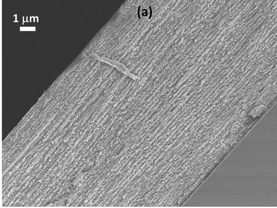
previous study on the influence of shear flow when drying CNC samples to make iridescent films, and the new component is a quantitative spectrophotometric study as a function of location in the films, together with a high-resolution electron microscopy characterization of the fractured films. It turns out that the reflection spectra are surprisingly similar between the two types of films, but the film cross section is very different. Whereas films dried with shear flow have a clearly periodic helical structure throughout the film, the ones dried without shear flow are disordered near the air interface. Because there is still a sufficiently thick internal regime, close to the bottom substrate, that is helical, the reflection spectra are similar, but the structural difference at the film top can have a strong effect on birefringence. The reflection spectra are much broader than what is expected for a cholesteric liquid crystal with well-defined pitch, indicating a variation in pitch within the film, which may be related to the polydispersity of CNC samples.
Read the article on the Cellulose website.
17 September 2016
Congratulations to Johanna and co-authors for the publication in Langmuir of the article "
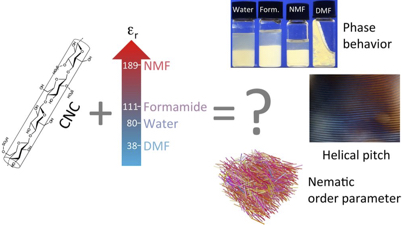
Enhancing Self-Assembly in Cellulose Nanocrystal Suspensions Using High-Permittivity Solvents". The team studied dispersion of Cellulose Nanocrystals (CNC) and the associated liquid crystal formation in water and in non-aqueous but polar solvents. Johanna developed a new method for exchanging the solvent of CNC suspensions from the water used during synthesis to formamide, N-methylformamide (NMF) and N,N-dimethylformamide (DMF), without inducing aggregation of the nanorods. She found striking differences between the solvents concerning the liquid crystal formation. The four solvents span a large range of dielectric permittivity, a parameter that turns out to be of key importance. The cholesteric helical superstructure develops much faster in high-permittivity NMF than in water and the pitch depends much less on CNC concentration than when water is the solvent. In low-permittivity DMF the first trace of liquid crystal formation coincides with kinetic arrest of the whole sample, preventing any helix formation since an equilibrium liquid crystal phase never develops. We propose that this is due to aligned aggregation of the CNC nanorods. The experimental results are corroborated by computer simulations done in Tanja Schilling's group, which furthermore indicate that the nematic order parameter goes up for high-permittivity solvents.
If you have an institutional subscription to Langmuir, you can
download the article here. If you do not, you can try the following link:
http://pubsdc3.acs.org/articlesonrequest/AOR-uVuBGBqpFzkXHmtihG36 . The first 50 to try this link can download the article for free, regardless of subscription.
We regret that the published Acknowledgments section unfortunately did not mention that Rick Dannert is a member of the Laboratory for the Physics of Advanced Materials of the University of Luxembourg and that this group kindly made their equipment (AFM, rheometer and refractometer) available for some of the experiments described in the paper. We deeply apologize for having forgotten this information in the published paper. Here we would like to express our deep gratitude for the support from the Laboratory for the Physics of Advanced Materials. 06 August 2016
Congrats to Catherine and Anshul, whose paper on non-electronic toluene vapor sensing using electrospun PVP fibers filled with nematic 5CB liquid crystal is now
available (Open Access) from the
Liquid Crystals website. In the article they demonstrate that there are two types of response to toluene vapor exposure, one slow and one fast. The slow one corresponds to a toluene diffusion-induced clearing transition, whereas the fast one is connected to a change in liquid crystal director field configuration, but the 5CB remains in the nematic phase. This fast response is seen across the mat within a fraction of a second, even several centimeters away from the exposure point, indicating that the detection threshold is very low. They also show that the responses of uniformly cylindrical fibers and beaded fibers are quite different, the latter allowing detection by the naked eye, without polarizers.
Download the paper (no subscription needed) here.
30 May 2016
Congrats to Yong on the
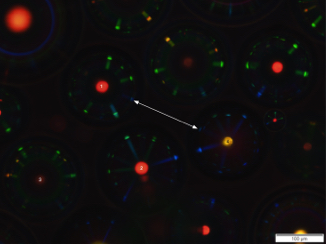
publication of his cholesteric microshells study in the journal Scientific Reports (Nature Publishing Group)! Together with JungHyun he succeeded in preparing shells from different cholesteric liquid crystal mixtures, giving selective reflection in different color ranges. He has developed a new method to rapidly remove defects by annealing through osmosis, and then he polymerizes a fraction of the mixture that is sufficient to make the shells robust under considerable mechanical deformation. With the help of our collaborators Romano Rupp (University of Vienna) and Irena Drevensek-Olenik (University of Ljubljana) we analyze the complex optics of the photonic cross communication between the shells, finding that the communication is active even between shells with different reflection colors, opening up new communication channels (picture). Finally, our collaborator at the Interdisciplinary Center for Security and Trust (SnT) at the University of Luxembourg, Dr. Gabriele Lenzini, provides a thorough and critical discussion on how the patterns generated by the shells may be used in secure authentication. The paper is Open Access, so please
download and read it at http://www.nature.com/articles/srep26840 (and make sure to check the nice movies in the Supporting Information!).
03 May 2016
Congratulations to Camila on her first scientific article since she joined our group: "
Equilibrium Liquid Crystal Phase Diagrams and Detection of Kinetic Arrest in Cellulose Nanocrystal Suspensions" by Camila Honorato Rios, Anja Kuhnhold, Johanna Bruckner, Rick Dannert, Tanja Schilling, and Jan P.F. Lagerwall, is now published (open access) in
Frontiers in Materials, section Biomaterials. In the article, we study the phase diagram and helical pitch behavior in the cholesteric phase of aqueous suspensions of cellulose nanocrystal (CNC) nanorods, as a function of mass fraction, surface charge and concentration of added inorganic salt. The study is a combined experimental and computer simulation thrust, where our group's experimental data are complemented by simulation results by Anja Kuhnold, in the
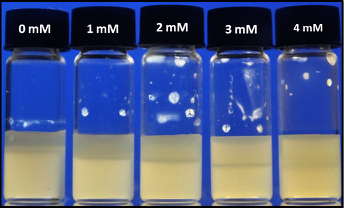
group of Prof. Tanja Schilling. An unexpected—and very interesting—observation is that the nature of the cholesteric-isotropic phase transition appears to change with ionic strength of the solvent. While it is strongly first order, as expected for lyotropic liquid crystals of hard-rod colloids, at low ionic strength, the barrier between isotropic and cholesteric phase appears to decrease upon salt addition, such that the isotropic phase becomes increasingly turbid as the ionic strength is increased. This is what is illustrated in the image, the concentration written at the top of each vial referring to the added salt; the CNC mass fraction is the same in all vials. The phenomenon reminds of the strong light scattering typical of critical fluctuations, normally seen only in the vicinity of a second order phase transition. You can
read and download the paper, without subscription (Frontiers of Materials is an open access journal),
by clicking on this link.
23 December 2015
Just in time for Christmas,
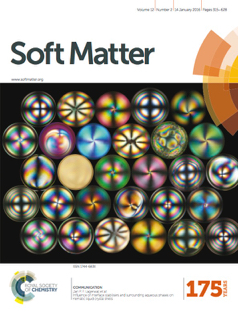
JungHyun's beautiful collection of liquid crystal shells got to decorate the
cover of issue 2 of volume 12 of Soft Matter. Her article "
Influence of interface stabilisers and surrounding aqueous phases on nematic liquid crystal shells", written together with
Kevin and
Jan, appears on page 367 of this issue. Congratulations on your second journal cover, JungHyun!
26 October 2015
Congratulations to JungHyun and Kevin! During Kevin's bachelor thesis work (supervised by JungHyun) they discovered a very surprising textural change during the nematic-isotropic transition of liquid crystal shells. This became the start of a detailed investigation of what the substances that surround liquid crystal shells, typically surfactants and random coil polymers dissolved in aqueous mixtures, actually do to the liquid crystal. Now this study has been accepted for publication as a Communication in
Soft Matter.
You can download the 'just accepted' version here, and you will then see that water actually enters the liquid crystal, affecting its clearing point, and surfactant can go through from one side to the other, turning a hybrid shell uniformly homeotropic after some time. On the other hand, if the surfactant concentration is too low, the alignment is planar, because then the planar-aligning influence of water dominates. Polymers like PVA just stabilize the shells, they don't affect the alignment.
05 August 2015
Congratulations to YooMee, whose M.Sc. research on the preparation of multiresponsive fibers, by electrospinning dual-core fibers with different liquid crystals next to each other, is now on-line at
Journal of Materials Chemistry C. The paper, published in collaboration with Prof. Changsoon Kim at Seoul National University, describes the possibilities opened by incorporating multiple liquid crystals in one and the same fiber, giving a single fiber multiple functions (like selective reflection and birefringence, as in the bottom right pane of the ToC graphic, reproduced here). Apart from the feat of producing the fibers, YooMee gives two messages of great practical importance concerning liquid crystal electrospinning. First, she confirms the
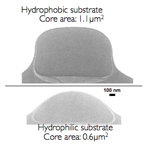
recent observation in a paper with DaeKyom as lead author, that electrospun core-sheath fibers must not be collected on hydrophilic substrates like ordinary glass or silicon chips, because then capillary forces from condensed water will deform the fibers. In YooMee's case, she found that the phenomenon even leads to mixing of the adjacent cores. Second, while ionic surfactants are a useful additive to the polymer solution in solid fiber spinning, since they increase the conductivity and reduce the surface tension, they are a bad choice when the fiber contains a liquid crystal core. YooMee found dramatic reductions in clearing point of the encapsulated liquid crystal whenever the polymer sheath solution contained surfactant, indicating that the surfactant actually enters the liquid crystal and disturbs its order.
Download her paper at Journal of Materials Chemistry C!28 May 2015
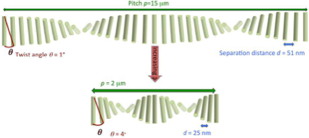
A new result from our fruitful collaboration with Stockholm University on cellulose nanocrystal suspensions appeared as an ASAP article in Langmuir today. It contains the best measurements of helix pitch in
equilibrium cholesteric suspensions to date, based on a combination of x-ray and optical diffraction measurements. You can
find the paper here.
29 August 2014
A beautiful study by Dae Kyom, demonstrating how capillary forces from water condensing on the outside of fibers during electrospinning can drastically influence the shape and core content of the fibers, is now published as an article in
ACS Applied Materials & Interfaces,
6,
18, 16441−16447 (2014). You can
find the paper here (subscription required).
03 April 2014
For a special issue of
ChemPhysChem on the physical properties and behaviour of liquid crystals, we
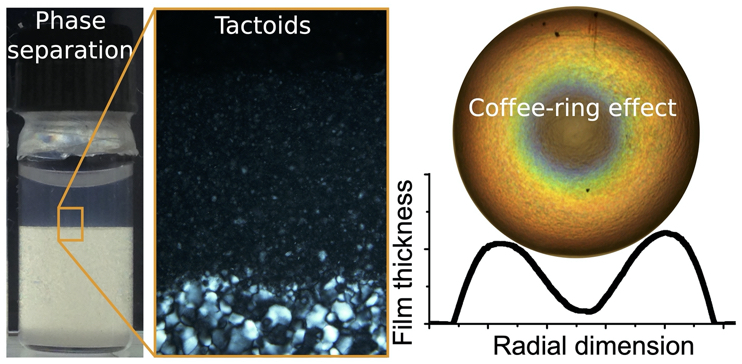
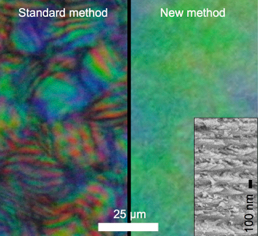
published a study on how the orientation and pitch of the helix in films formed by drying cholesteric liquid crystalline suspensions of cellulose nanocrystals (CNC) can be controlled with high accuracy based on a few simple considerations. The first point is that tactic boundaries, always present if one starts with suspensions that are in the phase coexistence regime, randomize the orientation of the helix, thereby giving rise to the irregular mosaic texture (left) often seen when drying films from low concentration CNC suspensions. By simply raising the concentration such that the initial suspension is fully liquid crystalline, a film with uniformly standing helix and much more uniform pitch can be achieved (right). Moreover, we show that an orbital shear flow can have a good effect in orienting the helix even when tactoids cannot be avoided. The work is a collaboration with the LC Nano lab of Prof. Giusy Scalia and the group of Prof. Lennart Bergström at the Materials and Environmental Chemistry Department of Stockholm University.
You can find the paper at the ChemPhysChem web site here. Unfortunately, we could not include color images in the final version of the paper, so be sure to also download the Supporting Information file, which contains all images in color version (the color is important for the discussion).
Note: if you want to learn more about liquid crystals from CNC, please
check out our recent review article (open access!) in NPG Asia Materials.