14 February 2020
We are very glad to have Assistant Professor Francesco Basoli from the Università Campus Bio-Medico in Rome, Italy, visiting us as invited researcher in March. He will support the INTERACT project with his expertise on electrospinning of functional polymer fibers.
\AS
29 June 2019
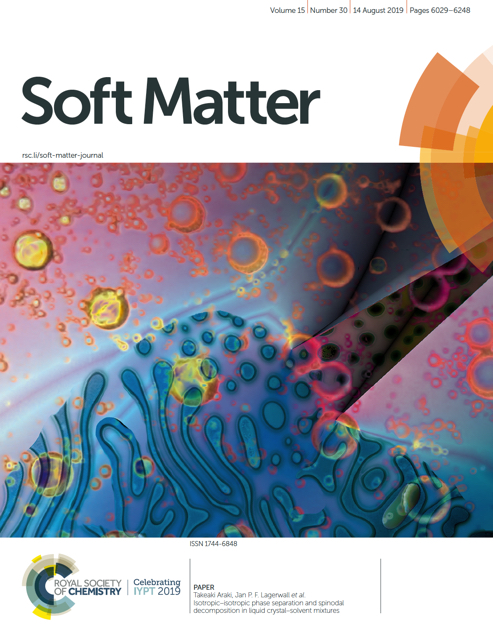
Congratulations to Catherine and Jan on the new publication RSC's Soft Matter:
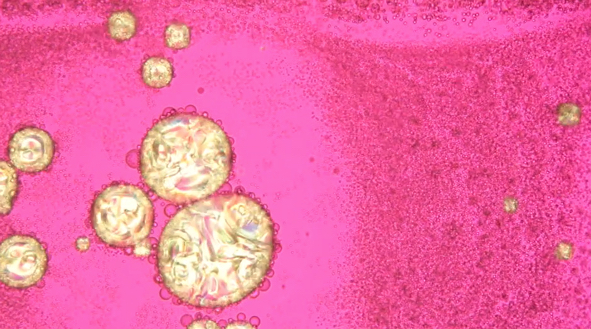
"Isotropic-Isotropic phase separation and spinodal decomposition in liquid crystal-solvent mixtures" experimentally & theoretically reveals evidence of coexisting isotropic phases in simple mixtures of ethanol, 5CB, and water. Even though the nematic LC 5CB is arguably the most studied commercial liquid crystal worldwide, for the first time this study highlights experimental evidence of spinodal decomposition and nucleation and growth occuring between two isotropic phases and a single nematic phase between this common compound and equally common solvents.
(Click the image below to visit the article:
All supplementary info is open access!)
\AS\
13 September 2018
. .

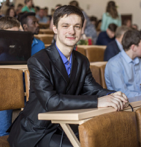
Welcome to our new post-doc Rijeesh (left) and phd Nikolay (right) who have joined our team. Rijeesh will be working on making cholesteric LC shells for reflector tags. While Nikolay will aim to generate tube-shaped liquid crystal elastomer actuators for biomedical applications.
/AS/
15 March 2018
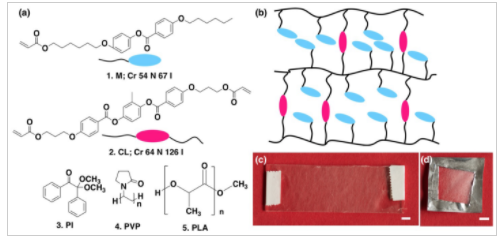
(Click the graphical abstract above to read the article online, it is Open-Access)
Congratulations to Anshul & Jan on the publication in Materials: “Electrospun Composite Liquid Crystal Elastomer Fibers”!
This is the first study to date that shows and analyzes the irreversible actuation of photo-crosslinkable reactive mesogens single axially electrospun with a carrier polymer, to create liquid crystal elastomer (LCE) fibers. Don't forget to check out the supplementary info for more details!
/CGR/
19 February 2018
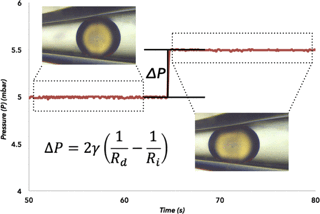
(Click the graphical abstract image above to access the article online, please email either Jan or Rao if you cannot download the pdf file)
Congratulations to Larry & Rao on the publication in Langmuir titled: “Microfluidic Tensiometry Technique for the Characterization of the Interfacial Tension between Immiscible Liquids”!
This is Larry's 1st paper in our group (!) and also Rao's 1st time serving as last author on a paper (!)
In this study, Larry and Rao borrow inspiration from the biologists and use the novel technique of micropipette aspiration (commonly used to measure the viscoelastic properties of living cells) to measure the interfacial tension of 5CB, water, and surfactants with a high degree of accuracy (from the sub-millinewton per meter to several hundred millinewton per meter range) solely from experimental observations of the droplet deformation. This is highly unique as information on the liquid density is not needed to find the interfacial tension.
/CGR/
11 July 2017
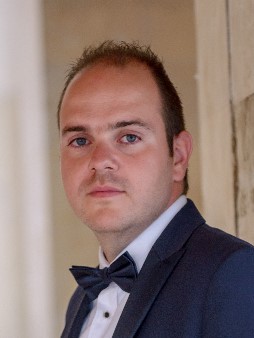
We're happy to welcome our new post-doc: Manos Anyfantakis! He officially joined the ESMP team at the start of July, and will mainly be working on advancing projects related to hydrodynamic flows, kinetic arrest, LC structure formation in the CNC work we have happening. He received his masters applied molecular spectroscopy in 2007, earned a phd in chemistry in Greece in 2010, and has since travelled to Germany and France for postdocs on the wetting of surfactant solutions and optofluidics phenomena before finally joining us in Luxembourg. You can contact Manos via e-mail here.
/CGR/
11 July 2017

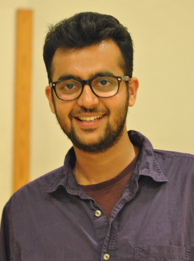
Welcome to both Anjali (left) and Shameek (right) who have joined our team as phd students starting in July.
Anjali will be working on making LC shells for advancing bio-related projects, while Shameek will be working on finding new polymers for advancing applications related to electrospun LC-fibers.
/CGR/
06 August 2016
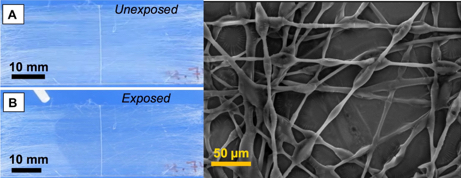
Congrats to Catherine and Anshul, whose paper on non-electronic toluene vapor sensing using electrospun PVP fibers filled with nematic 5CB liquid crystal is now
available (Open Access) from the
Liquid Crystals website. In the article they demonstrate that there are two types of response to toluene vapor exposure, one slow and one fast. The slow one corresponds to a toluene diffusion-induced clearing transition, whereas the fast one is connected to a change in liquid crystal director field configuration, but the 5CB remains in the nematic phase. This fast response is seen across the mat within a fraction of a second, even several centimeters away from the exposure point, indicating that the detection threshold is very low. They also show that the responses of uniformly cylindrical fibers and beaded fibers are quite different, the latter allowing detection by the naked eye, without polarizers.
Download the paper (no subscription needed) here.
13 March 2015
On the 12th of March 2015 the European Research Council (ERC)
publicized the list of this year's Consolidator Grant winners, making it official that Jan's proposal INTERACT was selected for support. The support means that for the next five years the Experimental Soft Matter Physics group will be working very actively on wearable technology, soft robotics and innovative techniques for secure authentication. As the project gets going (current projected starting date is 1st of April 2015) there will be many updates.