30 January 2026
Congratulations to ESMP alumna Deniz Avşar and ESMP overlord Jan on their newest publication in
Advanced Optical Materials, "
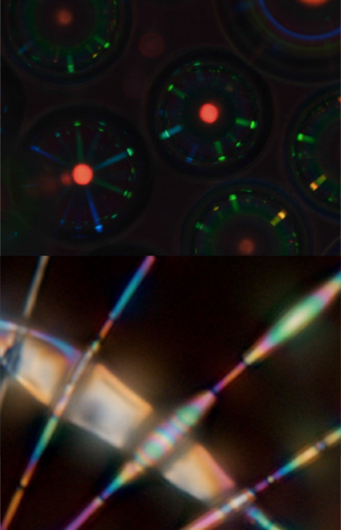
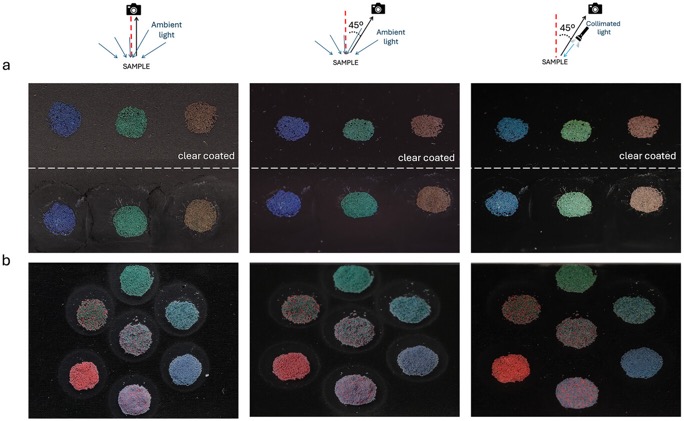
Circularly Polarized Structural Color Pigments Tunable Across the Full Visible Spectrum"! In this work, inspired in part by jewel beetles, Deniz and Jan (though especially Deniz) explore the camouflaging of patterns sensitive to circular polarization by using cholesteric spherical reflectors. By color mixing and dye infusion, they achieved color combinations that are virtually invisible to the unaided eye, but become very apparent when viewed through circular polarizers (like some of the glasses used for watching 3D movies in 3D).
The article is open access and free to read; a great start to 2026.
/LWH/
03 November 2025
It is our pleasure to welcome our first ALCEMIST Ph.D. candidate (and first of several ALCEMIST hires), Miriam Fischer!
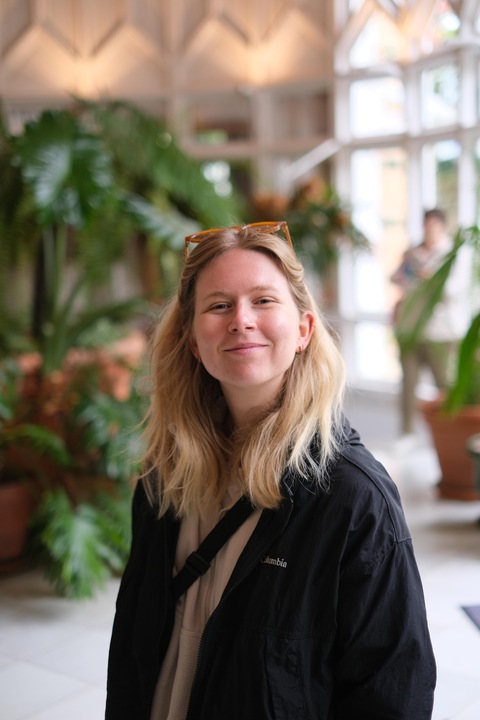
Originally from Germany and from the field of nanomagnetism, Miriam comes to us after finishing her Bachelor's and Master's degrees at the Johannes Gutenberg University of Mainz (Germany). She decided to take the plunge into soft matter physics and join us this year on the ALCEMIST project, working on transforming cellulose into liquid crystal elastomeric materials.
Häerzlech Wëllkomm, Miriam!
/LWH/
01 September 2025
It is our pleasure to congratulate three of the newest
Docteurs de l'Université du Luxembourg! And these defenses all happened in the same very busy last week, so lots of guests to welcome and lots to celebrate.
First up, on 25 August, Xu Ma defended her Ph.D. thesis, "Cholesteric Liquid Crystal Spheres for Visible and Infrared Operation: From Tunable Configurations to Continuous Production".
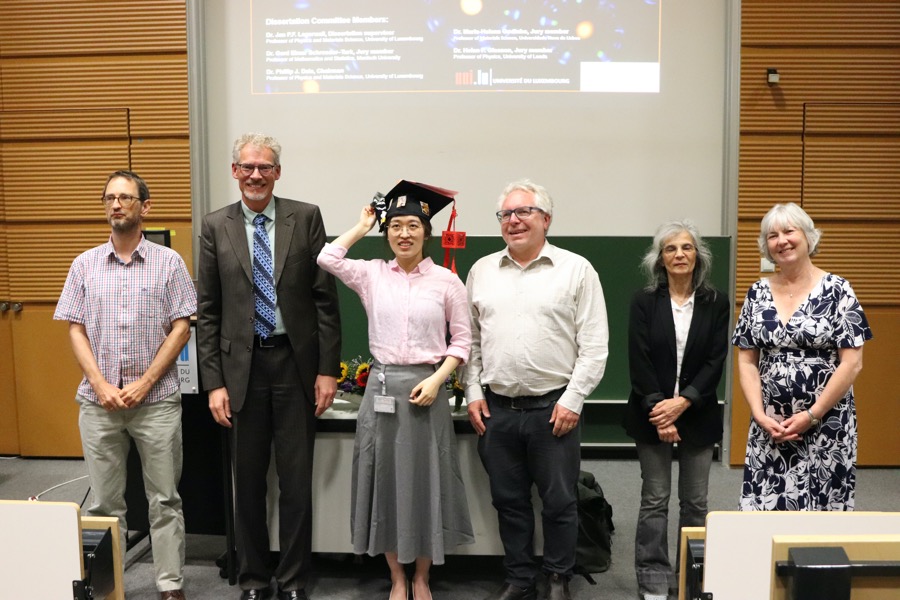
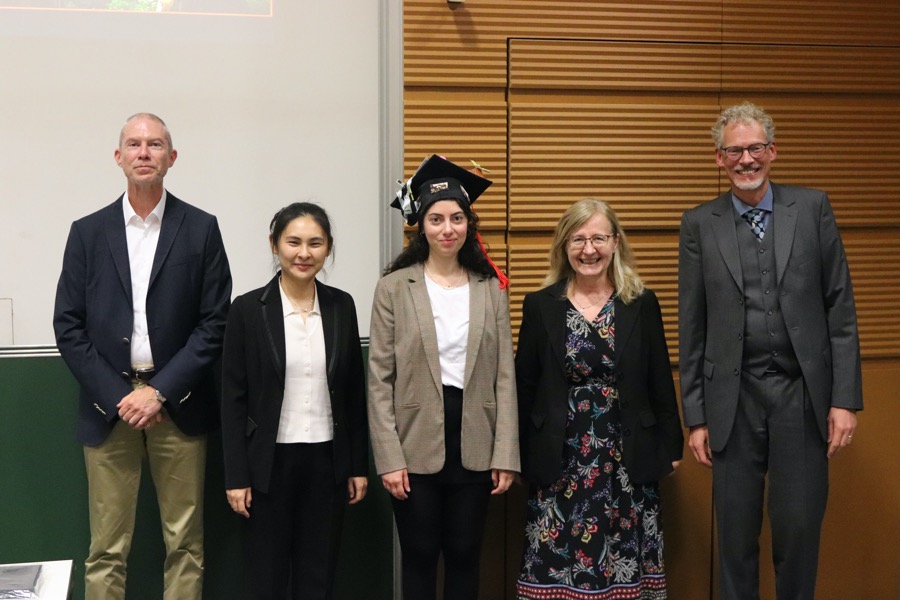
Secondly, on 27 August, Deniz Avşar defended her Ph.D. thesis, "Encoding Information as Unobtrusive Graphical Patterns Using Cholesteric Spherical Reflectors: From Optical and Materials Challenges to Applications in Robotics".
Finally, to round off the week, Nikolay Popov defended his Ph.D. thesis, "Impact of nonionic stabilizers and ionic solutes on liquid crystal shell stability and defect configuration", on Friday, 29 August.
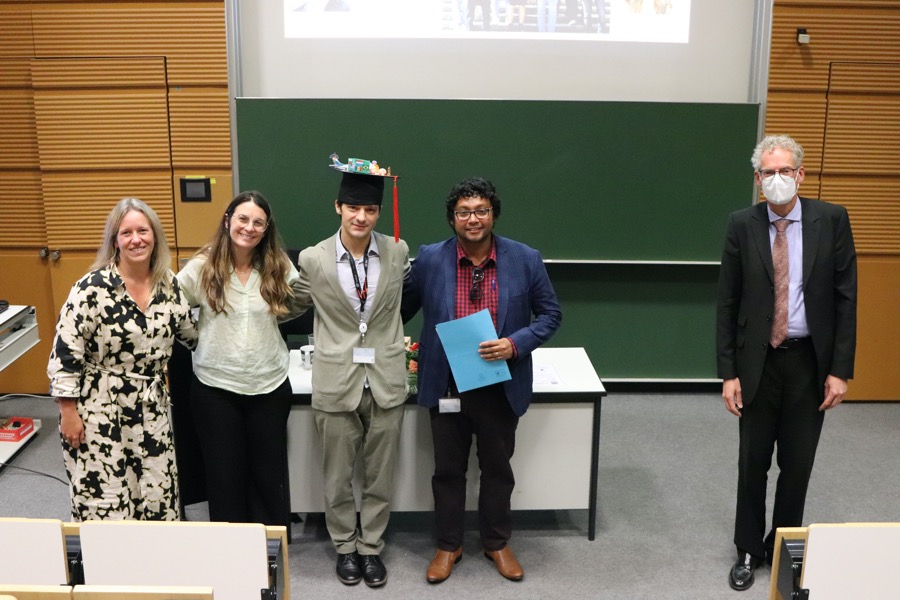
Häerzlech Gléckwonsch fir eis dräi néi Doktoren! / Félicitations à nos trois nouveaux docteurs ! / Congratulations to our three new doctors!
/LWH/
27 March 2025
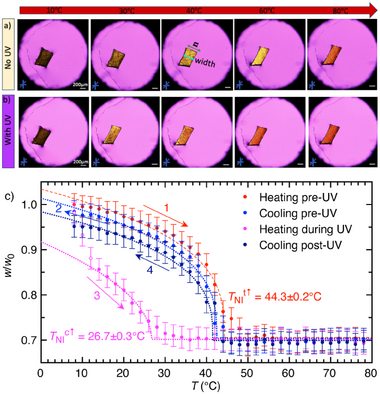
Congrats to Najiya and Jan for their recent publication, "
Oligomer-Derived Photoresponsive Liquid Crystal Elastomers with Biocompatible Operating Temperature", in
Advanced Optical Materials! In this work, they demonstrate liquid crystal elastomers capable of responding to light at temperatures close to body temperature, a step towards the aim of the ECLECTIC project of producing liquid crystal elastomer actuators for artificial vasculature. Accepted just in time for Najiya's recent PhD defense, it's now finally online for all to see.
\LWH\
10 March 2025
We here at ESMP want to congratulate the latest
Docteur de l'Université du Luxembourg en Chimie and our latest PhD graduate, Dr. Najiya! Najiya successfully defended her Ph.D. thesis,
Fabrication and Tailoring of Liquid Crystalline Elastomer Tubes: Toward Bio-Compatible Microactuators for Organoid Cultures, on 10 March.
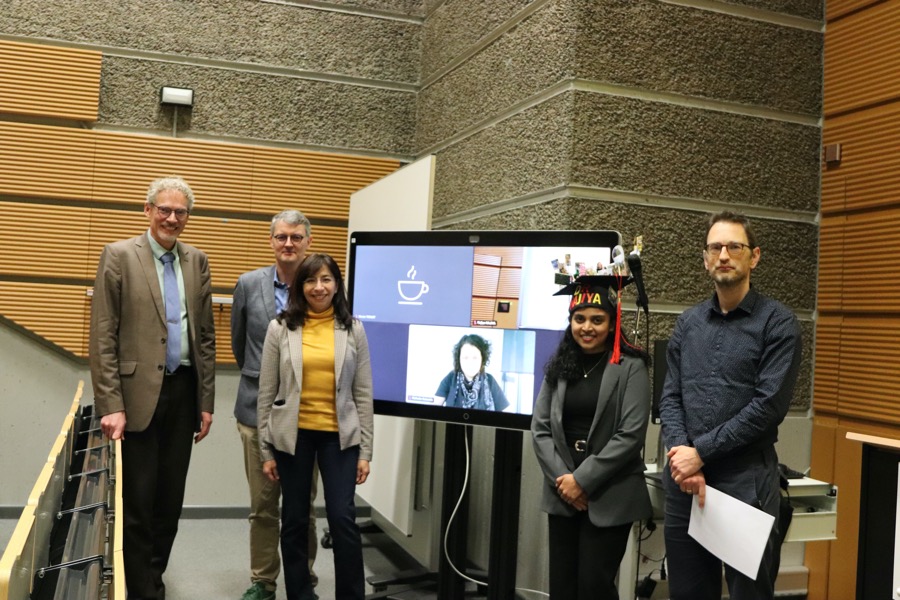
Häerzlech Gléckwonsch/Félicitations/Herzlich Glückwunsch, Najiya!
\LWH\
03 February 2025
As our first post for 2025, it is our pleasure to welcome our newest group members, Dr. Tadej Emeršič and Mr. Churchill Agoni, to ESMP!

Originally from Slovenia, where he completed his Ph.D., Tadej comes to us from the University of Chicago, where he worked as a postdoc in the group of Juan de Pablo. He joins us on the INVISIMARK project, a project in cooperation with the Luxembourg Ministry of Defense, in which he'll be working with us for (at least) the next year and a half on the use of CSRs for secure identification purposes.

Churchill comes from Nigeria and joins us after his Master's studies in Photonics at the University of Eastern Finland in Joensuu. He'll be working on the SHADOW project, a collaboration with the University of Ljubljana, on studying ferroelectric nematic liquid crystals under confinement.
\LWH\
09 October 2021
Congratulations to Dr. Shameek Vats who successfully defended his Ph.D thesis on Friday.
\XM
14 June 2021
Congratulations to Anjali who recently defended her Ph.D thesis on "Liquid Crystal Shells: from Physics Mysteries, via Chemistry Challenges, to Biosensing Opportunities”.
\AS
04 December 2020
Welcome our new PhD candidate Najiya to the ESMP. Najiya will be working on "Physics meet Biology " scheme, specifically on research in liquid crystal elastomers for artificial vasculature for sustaining organoid growth.
\AS
31 May 2020
Many congratulations to Catherine and Jan for the new article "
Disruption of electrospinning due to water condensation into the Taylor cone", published in
ACS Applied Materials & Interfaces. This paper has open access.
\AS
17 October 2019
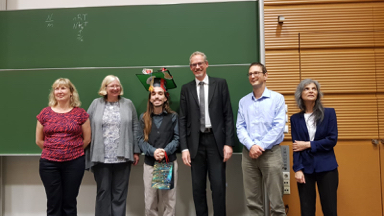
Congratulations to Larry! Who recently defended his Ph.D thesis on
"Liquid Metals and Liquid Crystals Subject to Flow: From Fundamental Fluid Physics to Functional Fibers"
\AS
03 September 2019
Congratulations to Anjali, Jampani, and Jan on their new article published in Langmuir: "
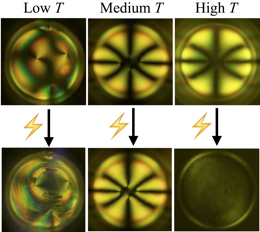
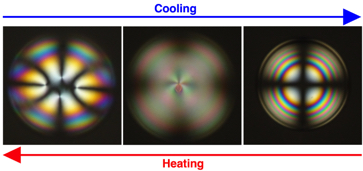
Realignment of liquid crystal shells driven by temperature-dependent surfactant solubility"This is the study of nematic LC shells stabilized by temperature responsive surfactant. Study shows how one can change the alignment of LC just by varying the temperature. Click
here for the full article.
\AS
28 June 2019
Our Ph.D student Anjali Sharma was featured on FNR's Spotlight on Young Researchers blog! :D
Anjali works on forming liquid crystal shells and she works on trying to stabilize them using different surfactants and polymers.
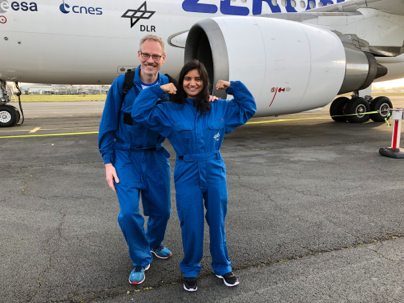
Anjali and the team (Jampani, Nikolay and Jan from our group) + others from Prof. Ralf Stannarius's group in Magdeburg, Germany, observed LC shell behavior in a micro gravity environment made possible through several parabolic flights initiated in a plane provided by the German Aerospace Center (
DLR)
Read about & see her experience here on the FNR's site:
Spotlight on Young Researchers: Anjali Sharma
Anjali’s PhD is funded by the FNR’s PRIDE programme in the framework of the Doctoral Training Unit (DTU) MASSENA, which has the goal to improve the understanding and the performance of materials used in sensing and energy harvesting
\CGR\
19 September 2018
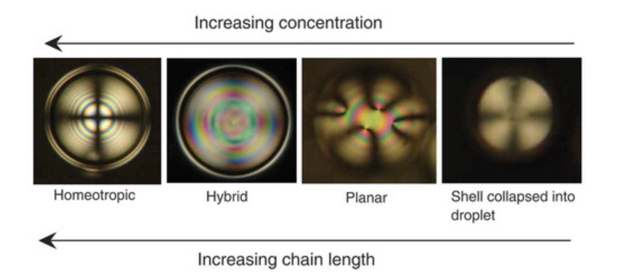
Congratulations to Anjali & Jan on the new publication in Liquid Crystals: "Influence of head group and chain length of surfactants used for stabilising liquid crystal shells"
This is the systematic study of the effect of different surfactants on Nematic LC shell, in terms of stability and alignment.
/AS/
13 September 2018
. .

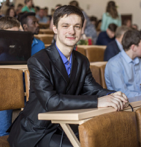
Welcome to our new post-doc Rijeesh (left) and phd Nikolay (right) who have joined our team. Rijeesh will be working on making cholesteric LC shells for reflector tags. While Nikolay will aim to generate tube-shaped liquid crystal elastomer actuators for biomedical applications.
/AS/
19 February 2018
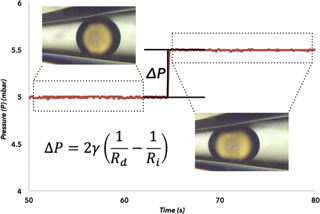
(Click the graphical abstract image above to access the article online, please email either Jan or Rao if you cannot download the pdf file)
Congratulations to Larry & Rao on the publication in Langmuir titled: “Microfluidic Tensiometry Technique for the Characterization of the Interfacial Tension between Immiscible Liquids”!
This is Larry's 1st paper in our group (!) and also Rao's 1st time serving as last author on a paper (!)
In this study, Larry and Rao borrow inspiration from the biologists and use the novel technique of micropipette aspiration (commonly used to measure the viscoelastic properties of living cells) to measure the interfacial tension of 5CB, water, and surfactants with a high degree of accuracy (from the sub-millinewton per meter to several hundred millinewton per meter range) solely from experimental observations of the droplet deformation. This is highly unique as information on the liquid density is not needed to find the interfacial tension.
/CGR/
11 July 2017

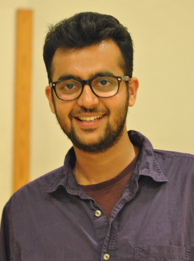
Welcome to both Anjali (left) and Shameek (right) who have joined our team as phd students starting in July.
Anjali will be working on making LC shells for advancing bio-related projects, while Shameek will be working on finding new polymers for advancing applications related to electrospun LC-fibers.
/CGR/
17 February 2017
The J
ournal of Physics - Condensed Matter by IOP Publishing has just released our groups' newest review article titled
Liquid Crystals in Micron-Scale Droplets, Shells, and Fibers, and it's open access!
(<— Click to check it out)
With careful and succinct discussions of various topics ranging from the characterization of typical liquid crystalline (LC) phases, to the complexities surrounding LC defects under confinement, we're sure that this review will soon become known as one of the "go-to" manuals for both liquid crystal physicists, and chemists; those just beginning in the field, and veteran researchers alike.
In considering the long length of the article, we've carefully sub-sectioned the important works, advancements, and ongoing research contributing to how liquid crystals behave in each of the major curved configurations (i.e. droplets, shells, and fibers). This was done so that anyone interested in knowing more about a particular topic can easily find the right section without having to start reading from the very beginning. At the same time, we include a number of cross-references serving as reminders for the reader to review certain previously described concepts when necessary.
Finally, at the end of each configuration topic we conclude the sections by highlighting the latest research trends which the LC field has shown interest in — for LCs in droplets and shells, it ends with a discussion of active and motile LC systems (inspired by the flocking mechanism in many biological systems) and liquid crystal elastomer (LCE) actuating shells. For LCs in polymer fiber confinement, the section ends with a discussion on textile based gas responsive visual aids, and comparisons to current gas sensing systems.
Here's a brief outline of every section & contents within:
1. Intro
2. The liquid crystalline states of matter [thermotropic nematics & smectics, order parameter, clarification of terminology for LC orientations, LC deformations & elasticity, cholesterics, LC elastomers (LCEs)]
3. Liquid crystal shells and droplets [microfluidics - what it is, how it works for making LC shells & droplets; issues surrounding interface stabilization & LC alignment control within; topological defects for nematic, cholesteric, smectic droplets and shells; droplet & shell LCE actuatiors; active LC droplets & shells]
4. Core-sheath fibers with encapsulated LC [known behaviors of nematics, smectics, cholesterics in silica cylindrical capillaries; electrospinning basics for inserting LCs into polymer cylindrical (and non-cylindrical) fibers; issues surrounding solvent, polymer concentration and molecular weight choices with particular LCs; various LC molar mass types in polymer fibers; LCE fibers and gas sensing applications]
5. Outlook
/CGR/
30 September 2016
Congratulations to JungHyun and Benjamin for their new
Adv. Mater. paper "
Taming Liquid Crystal Self-Assembly: The Multifaceted Response of Nematic and Smectic Shells to Polymerization" on polymer-stabilization of nematic and smectic liquid crystal shells, and the sometimes unexpected consequences for the liquid crystal self-assembly. By polymerizing a small fraction of the reactive mesogen RM257 in shells of 8CB or its homologues, certain defect configurations can be locked in place, the exact result depending sensitively on the mixture composition and the temperature at which polymerization is carried out. Surprisingly, when polymerizing close to a phase boundary, a transition into the adjacent phase can be induced. The new phase can be more or less ordered, depending on the starting situation. The lifetime of the shells is dramatically enhanced, as is the temperature stability. By tuning the conditions, the self-assembled structure can be made fully permanent, being visible even upon heating to the isotropic phase of the non-polymerized component, or it can be retained in a latent state, allowing macroscopic loss of order on heating to the isotropic phase yet with a memory of the chosen defect configuration when cooling down. Apart from proposing explanations for the various observations we discuss possibilities to apply the polymer-stabilized shells, for instance in advanced materials generation or in sensing.
Here you can find the full paper (don't forget to check out the rich supporting information, including many spectactular movies), and here is a layman's abstract for the paper.
06 August 2016
Congrats to Catherine and Anshul, whose paper on non-electronic toluene vapor sensing using electrospun PVP fibers filled with nematic 5CB liquid crystal is now
available (Open Access) from the
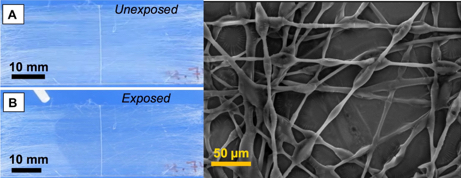
Liquid Crystals website. In the article they demonstrate that there are two types of response to toluene vapor exposure, one slow and one fast. The slow one corresponds to a toluene diffusion-induced clearing transition, whereas the fast one is connected to a change in liquid crystal director field configuration, but the 5CB remains in the nematic phase. This fast response is seen across the mat within a fraction of a second, even several centimeters away from the exposure point, indicating that the detection threshold is very low. They also show that the responses of uniformly cylindrical fibers and beaded fibers are quite different, the latter allowing detection by the naked eye, without polarizers.
Download the paper (no subscription needed) here.
23 December 2015
Just in time for Christmas,
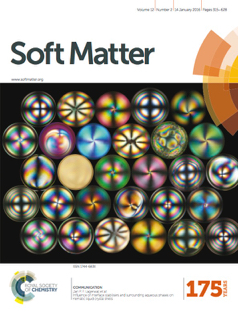
JungHyun's beautiful collection of liquid crystal shells got to decorate the
cover of issue 2 of volume 12 of Soft Matter. Her article "
Influence of interface stabilisers and surrounding aqueous phases on nematic liquid crystal shells", written together with
Kevin and
Jan, appears on page 367 of this issue. Congratulations on your second journal cover, JungHyun!
26 October 2015
Congratulations to JungHyun and Kevin! During Kevin's bachelor thesis work (supervised by JungHyun) they discovered a very surprising textural change during the nematic-isotropic transition of liquid crystal shells. This became the start of a detailed investigation of what the substances that surround liquid crystal shells, typically surfactants and random coil polymers dissolved in aqueous mixtures, actually do to the liquid crystal. Now this study has been accepted for publication as a Communication in
Soft Matter.
You can download the 'just accepted' version here, and you will then see that water actually enters the liquid crystal, affecting its clearing point, and surfactant can go through from one side to the other, turning a hybrid shell uniformly homeotropic after some time. On the other hand, if the surfactant concentration is too low, the alignment is planar, because then the planar-aligning influence of water dominates. Polymers like PVA just stabilize the shells, they don't affect the alignment.
15 April 2015
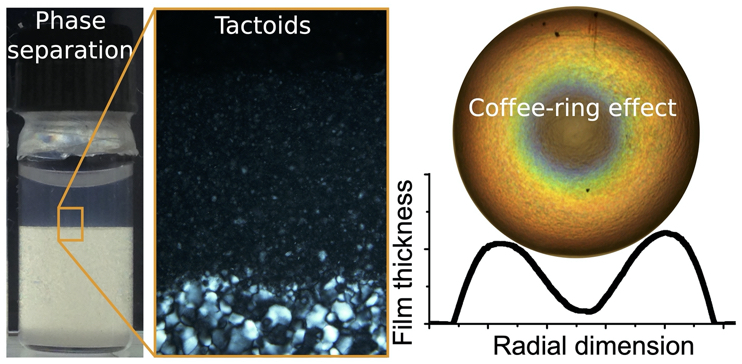
We welcome Camila Honorato as a member of our group! She will be working as a doctoral candidate in the MISONANCE project, carried out in collaboration with the team of Prof. Tanja Schilling at PhyMS, UL. Camila will study the self-assembly of water-suspended cellulose nanocrystals into lyotropic liquid crystal phases, and how this self-assembly competes with the tendency of electrostatically charged nanorod suspensions to arrest into a jammed state. She will interact closely with Anja Kuhnold from Prof. Schilling's group, who is doing theory and computer modeling corresponding to Camila's experiments.
15 January 2015
It is with great pleasure that we welcome our new Ph.D. candidate, Catherine Reyes, coming from Cornell University where she carried out her Master studies with Prof. Margaret Frey. Catherine should have arrived already in September but the paper work for allowing a US citizen and Cornell graduate to start as Ph.D. candidate in Luxembourg turned out to be beyond our wildest imagination… Anyway, she is finally here and she will be working full time on liquid crystal-functionalized electrospun fibers for wearable technology.